A $100,000 salary in January 2021 needed to be $126,725 by August 2026 to buy the same groceries, pay the same rent and fill the same fuel tank. Prices rose 26.7% between January 2021 and August 2026 (ABS, year to August 2026), and most Australian workers have not had a 27% pay rise in that time.
The question isn't whether you got a raise. It's whether you got a real raise — one that actually beat inflation. Here is how to calculate the exact dollar gap at your income, what the tax cuts restored, and what the ABS data says about whether your industry is keeping up.

The five-year inflation hit: year by year
Here is how ABS All Groups CPI (catalogue 6401.0) compounded across each calendar year since January 2021. The "salary needed" column shows what a $100,000 salary in January 2021 requires at each milestone to keep the same purchasing power:
| Year | CPI rate | $100k salary needed | Cumulative gap |
|---|---|---|---|
| 2021 | 3.5% | $103,500 | $3,500 |
| 2022 | 7.8% | $111,573 | $11,573 |
| 2023 | 4.1% | $116,147 | $16,147 |
| 2024 | 2.4% | $118,935 | $18,935 |
| 2025 | 3.8% | $123,455 | $23,455 |
| Aug 2026 | 4.0% (year to August) | $126,725 | $26,725 |
The damage accelerated in 2022 (7.8%, the post-COVID supply-chain peak) and has not slowed enough since. After the 2024 low of 2.4%, CPI rose to 4.6% in the year to March 2026, eased to 3.5% in the year to July, and was back at 4.0% in the year to August 2026. Housing (up 5.7%) and transport (up 5.6%, mostly fuel) were the largest contributors (ABS, released 30 September 2026). The 2026 row counts the eight months to August at that 4.0% rate.
Enter your salary and the date of your last pay rise — the calculator compounds CPI across every year in between and shows your real income loss in 30 seconds.
Open Pay Rise Calculator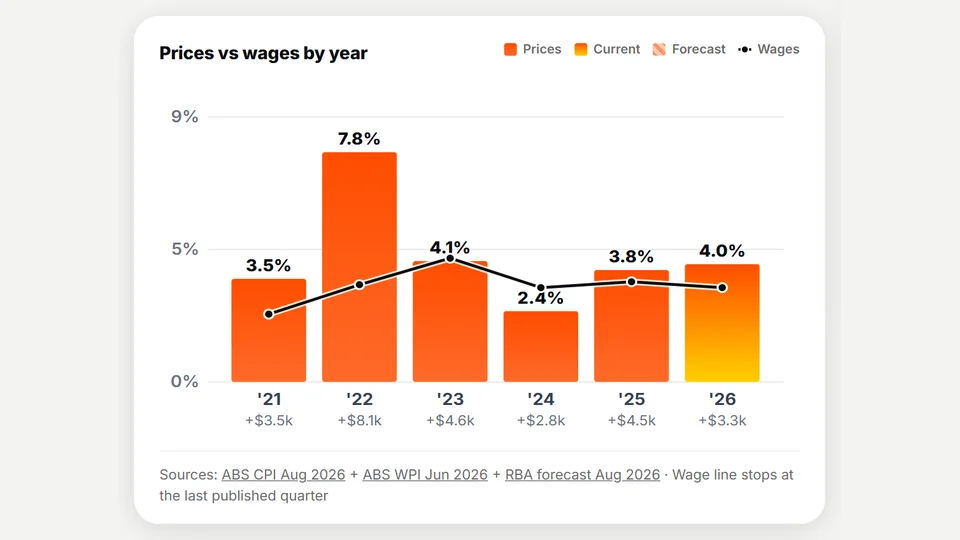
Wage growth vs CPI: the ABS says you're still losing
The ABS Wage Price Index (WPI, catalogue 6345.0) measures how much employers are paying per hour of labour. It rose 3.2% in the year to the June quarter 2026 (ABS, released 19 August 2026). CPI rose 3.8% in the year to June 2026.
That is a 0.6 percentage point real-wage cut over the year to June 2026. From January 2021 to June 2026, wages rose about 19% while prices rose about 26%, a gap of about 6 percentage points. The average Australian worker bought less in mid-2026 than in early 2021, even after several pay rises.
Wage growth differs by industry. The ABS publishes WPI for each industry every quarter in catalogue 6345.0; check yours before you negotiate.
What the tax cuts actually restored
The income tax brackets that took effect on 1 July 2024 reduced income tax at every level above $18,200, and the bottom rate fell again, from 16% to 15%, on 1 July 2026. Here is the annual saving by income, and how much of the inflation gap the 2026–27 saving closes:
| Income | Tax saving 2024–25 & 2025–26 | Tax saving 2026–27 | Inflation gap (Jan 2021 → Aug 2026) | % restored (2026–27) |
|---|---|---|---|---|
| $45,000 | $804 | $1,072 | $12,026 | 9% |
| $80,000 | $1,679 | $1,947 | $21,380 | 9% |
| $100,000 | $2,179 | $2,447 | $26,725 | 9% |
| $135,000 | $3,729 | $3,997 | $36,079 | 11% |
| $190,000+ | $4,529 (max) | $4,797 (max) | $50,778 | 9% |
The tax cuts help, but in 2026–27 they restore only about 9–11% of the gap. For a $100k earner, that's $2,447 a year against a $26,725 gap (the saving was $2,179 in 2024–25 and 2025–26). The rest has to come from pay.
Watch the $105k threshold trap: if your pay rise pushes you across $105,000 (the 2026–27 single threshold; it was $101,000 in 2025–26) and you don't hold private hospital cover, the Medicare Levy Surcharge applies at 1% of your whole income for MLS purposes, adding at least $1,050 a year on top of normal tax. A $10,000 pay rise from $98k to $108k looks like a 10% raise but also brings $1,080 of MLS that wasn't there before. Run your before-and-after with the Velofy Medicare Levy + MLS calculator before you negotiate — it's the difference between a clean pay rise and one that gives money back to the ATO. For the tier tables for both years, see the Medicare Levy Surcharge thresholds guide; for whether hospital cover costs less than the surcharge at your income, see Hospital cover or MLS: the verdict at your income.
How to ask for an inflation-matching pay rise
Three steps backed by data:
- Calculate your inflation-adjusted salary using the pay rise calculator. That gives you the exact dollar figure you need to be at parity — not a vague "I deserve more" but a verifiable number anchored to ABS data.
- Pull your industry's WPI growth from ABS catalogue 6345.0 and the latest Fair Work annual wage review as comparative benchmarks.
- Frame the request as real-income restoration, not a "raise". Present the year-on-year CPI accumulation alongside any productivity contribution. "I'm asking for restoration to parity, not a premium" is a different negotiation than "I want more money."
Your exact inflation-adjusted target salary, the gap, and the tax-cut offset — in 30 seconds.
Open Pay Rise CalculatorRBA forecast: where inflation goes from here
The RBA's August 2026 Statement on Monetary Policy (published 11 August 2026) forecast headline CPI at 3.6% in the year to December 2026, 2.8% by June 2027, 2.6% by December 2027 and 2.4% through 2028. It expected inflation to have peaked in the June quarter of 2026. On 29 September 2026 the RBA raised the cash rate to 4.60%, its fourth rise of 2026. If your employer says "inflation is coming down," they may be right about the trend, but not about the level. Prices don't drop when inflation falls; they just rise more slowly. The gap you've already lost stays unless you get a raise that closes it.
The pay-rise calculator also projects forward using RBA forecasts, so you can see what you'd need in 2027 or 2028 if your employer offers a future raise instead of a current one.
Frequently Asked Questions
How much has inflation risen in Australia since 2021?
About 26.7% from January 2021 to August 2026. Each year's rise is counted on top of the last: 3.5% in 2021, 7.8% in 2022, 4.1% in 2023, 2.4% in 2024, 3.8% in 2025, and 4.0% in the year to August 2026 (released 30 September 2026), counted for the eight months to August. A $100,000 salary in January 2021 needed to be about $126,725 by August 2026 to buy the same things. Source: ABS consumer price index (CPI).
What is a 'real' pay rise versus a 'nominal' pay rise?
A nominal pay rise is the number in your new contract: a 3% rise takes $100,000 to $103,000. A real pay rise allows for inflation. If prices rose 4% over the same time, your $103,000 buys less than your $100,000 did a year ago, so your real pay fell by about 1% even though you got a 3% rise. The ABS wage price index (WPI) tracks pay rises across the economy; when it's below inflation, average real wages are falling.
Did the 2024 tax cut offset inflation for most workers?
Partly. The tax cuts from 1 July 2024 added $804 a year to take-home pay at $45,000, $1,679 at $80,000, $2,179 at $100,000, and up to $4,529 above $190,000. With the 15% bottom rate from 1 July 2026, the 2026–27 savings are $1,072, $1,947, $2,447 and up to $4,797. For someone whose last pay rise was in January 2021, prices rose about 27% to August 2026, a $26,725 gap on $100,000. The $2,447 saving covers about 9% of it. It helps, but it doesn't close the gap.
What is the current Wage Price Index growth rate in Australia?
In the year to the June quarter 2026 it was 3.2% (ABS, released 19 August 2026). Prices rose 3.8% in the year to June 2026, so on average real wages fell over that year, and inflation was 4.0% in the year to August 2026. The ABS publishes a new WPI figure every quarter, with a breakdown by industry, at abs.gov.au.