You have two job offers on the table. One pays $100,000. The other pays $95,000. The higher salary wins, right?
Not always. If the $95,000 job is at a charity that can offer salary packaging (a public benevolent institution), up to $18,550 of your pay can be received tax-free. On 2026–27 tax rates, that leaves you about $2,536 a year more take-home pay than the $100,000 job without packaging. The $100,000 job still pays $600 a year more super, so the gap narrows once super counts.
Salary is one of six things that decide what an offer is worth. The others are super, bonus, salary packaging, leave and commute cost. Three worked scenarios below show when the higher offer comes out ahead and when it doesn't.
All take-home figures use 2026–27 tax rates from the Velofy tax engine and include the 2% Medicare levy. They assume private hospital cover, so no Medicare levy surcharge applies. Most packaged benefits count towards the surcharge income test and HECS repayment income, so check both if they apply to you.

The six variables that move the needle
Every job comparison should cover these six inputs. Miss any one of them and you can be off by thousands per year:
| Variable | Why it matters | Typical impact |
|---|---|---|
| Base salary | Taxed at your marginal rate. The obvious one. | After tax, $10k more base is $6,800 more take-home in the $45,001–$135,000 bracket (30% plus 2% Medicare). |
| Super % | 12% is the legal minimum. Some employers pay more. | 1% extra at $100k = about $76,800 after 30 years (about $25,800 in today's dollars), after 15% contributions tax, at 7% a year less 0.25% fees. |
| Bonus | Target × likelihood. Count only the part you expect to receive. | $20k bonus at 50% = $10k expected value, taxed at marginal rate. |
| Salary packaging | FBT-exempt employers let you receive salary tax-free up to a cap. | Hospital cap of $11,660 saves $3,731/yr in the 30% bracket (30% plus 2% Medicare). |
| Leave days | 20 days is the minimum for full-time staff. Each extra day is worth a day's pay. | 5 extra days at $100k = about $1,920/yr. |
| Commute cost | Paid from after-tax dollars. $50/week = $2,500/yr less take-home. | Working from home vs a $50/wk CBD commute = $2,500 swing. |
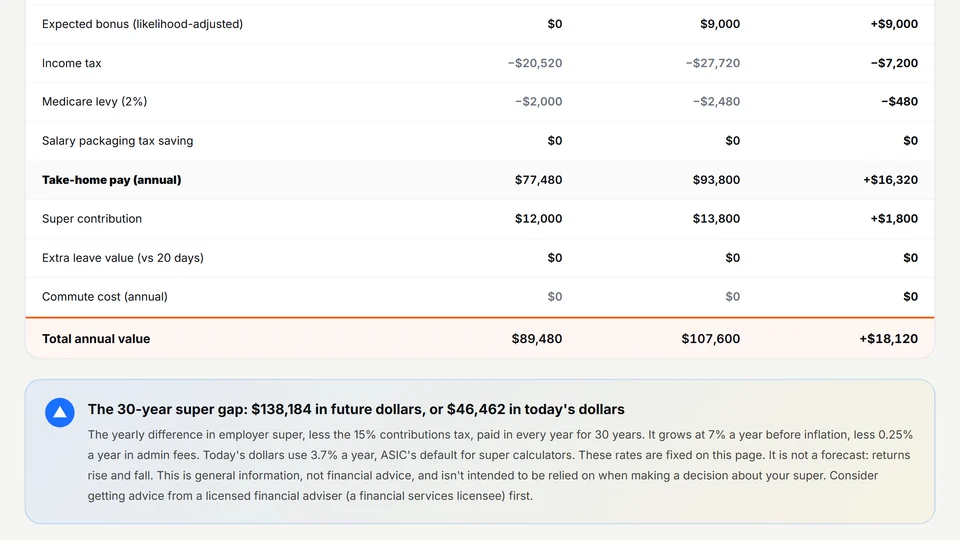
Enter all six variables for each job. Get a single bottom-line verdict in real dollars — plus the 30-year super gap.
Open Job Offer Comparison CalculatorScenario 1: Higher super or higher salary?
Job A: $100,000 base + 13% super + no bonus. Job B: $105,000 base + 12% super + no bonus.
- Job A super contribution: $13,000/yr. Job B: $12,600/yr. Difference: $400/yr in Job A's favour.
- Job B's extra $5,000 is taxed at 30% plus the 2% Medicare levy, leaving $3,400 more take-home ($80,880 vs $77,480).
- Job A's extra $400/yr of super, after 15% contributions tax, grows to about $30,700 over 30 years (about $10,300 in today's dollars) at 7% a year less 0.25% fees.
Job B still comes out ahead. It could salary-sacrifice $400 a year to match Job A's super and still take home $3,128 more ($80,608 vs $77,480). Higher super wins only when the salary gap is small next to the super gap.
Scenario 2: The bonus mirage
Job A: $130,000 flat salary. Job B: $115,000 + $30,000 target bonus at 50% likelihood.
Job B's expected bonus = $30,000 × 50% = $15,000. Total expected gross = $130,000. Looks equal.
After tax it is still equal on expected values. $115,000 plus a $15,000 bonus stays inside the 30% bracket, which runs to $135,000, so the expected bonus leaves $10,200 after tax — the same as Job A's extra $15,000 of salary. Both come to $97,880 take-home.
The difference is risk. If Job B pays the full bonus, take-home is $107,380. If it pays nothing, it is $87,680. Job A leaves $97,880 every year, with no performance review attached.
At equal expected value, certainty wins. Job B needs to offer a higher expected total to make up for the risk — what economists call a risk premium.
Scenario 3: The healthcare packaging edge
Job A: $120,000 at a private company + 12% super. Job B: $108,000 at a public hospital + 12% super + $9,010 general packaging + $2,650 meal entertainment.
Job A looks $12,000 ahead. But Job B's $11,660 of FBT-exempt salary packaging is received tax-free. In the 30% bracket, that saves:
- $11,660 × 30% = $3,498 in income tax
- Plus the 2% Medicare levy on the packaged amount: $233
- Total packaging value: $3,731/yr
After tax, Job A leaves $91,080. Job B leaves $82,920 without packaging, or $86,651 with it. The gap shrinks from $12,000 before tax to about $4,429 after tax. Job A also pays $1,440 a year more super, because 12% of a higher salary is more. If Job B offers 25 days of leave against Job A's 20, the 5 extra days are worth about $2,077 (5 days of a $108,000 salary), bringing the take-home gap to about $2,350.
For nurses, allied health workers and charity staff, packaging is often the single biggest variable in a job comparison. The job comparison calculator models this automatically — select "Healthcare / hospital" or "Charity / PBI" from the packaging dropdown.
Enter both offers side by side — base, super, bonus, packaging, leave, commute. Single verdict in 60 seconds.
Open Job Offer Comparison CalculatorThe 30-year super gap most comparisons ignore
A yearly difference in super keeps growing for the rest of your career. Take $1,000 a year more employer super. After the 15% contributions tax, $850 goes in each year. At 7% a year before inflation, less 0.25% a year in admin fees, that grows to about $76,769 after 30 years. In today's dollars that is about $25,812, using 3.7% a year, ASIC's default for super calculators.
The median growth super fund returned 7.6% a year over the 10 years to May 2026, after investment fees and tax (Chant West). 0.25% is about the median MySuper admin fee on a $50,000 balance (APRA, year to 30 June 2025).
The gap grows with the size of the contribution difference. Figures are after the 15% contributions tax, in future dollars, with today's dollars in brackets:
| Annual super gap | Over 20 years | Over 30 years |
|---|---|---|
| $1,000/yr (1% at $100k) | $33,910 ($16,396) | $76,769 ($25,812) |
| $1,500/yr (1% at $150k) | $50,864 ($24,594) | $115,154 ($38,718) |
| $3,000/yr (3% at $100k) | $101,729 ($49,189) | $230,307 ($77,436) |
The calculator shows both figures under every comparison.
If the gap goes the wrong way — your preferred offer pays less super than the alternative — you can close it by salary sacrificing extra into super from the higher salary. In the 30% bracket you save 17 cents in tax on every dollar redirected; in the 37% bracket, 24 cents. Model the dollar saving and the 30-year effect with the Velofy salary sacrifice calculator.
When the numbers matter less
When the yearly gap between two offers is under about $5,000, things like the manager, the team, flexibility and what you will learn often matter more. Over a two- or three-year stint, a $5,000 gap adds up to $10,000–$15,000: meaningful, but not life-changing.
Above about $15,000 a year, the money is harder to ignore. A job that pays $20,000 a year more is $60,000 more before tax over three years — enough to make a real difference to a mortgage, a super balance or savings.
Frequently Asked Questions
How much is 1% extra super worth over a career?
More than it looks. On a $100,000 salary, 1% extra super is $1,000 a year. After the 15% tax super funds pay on contributions, $850 of it goes in. Over 30 years, at 7% a year before inflation less 0.25% a year in admin fees, that grows to about $76,800, or about $25,800 in today's dollars. On $150,000, the same 1% grows to about $115,200, or about $38,700 in today's dollars. Source: Velofy calculation; today's dollars use 3.7% a year, ASIC's default for super calculators.
What is FBT-exempt salary packaging and who qualifies?
It lets some employers pay part of your salary as tax-free benefits, so less of your pay is taxed. Staff of public and not-for-profit hospitals and public ambulance services can package up to $9,010 a year, plus $2,650 for meals and entertainment: $11,660 in all. Staff of registered charities known as public benevolent institutions, and of health promotion charities, can package up to $15,900 plus $2,650 ($18,550). Your yearly saving is roughly the packaged amount times your marginal tax rate. Source: ATO.
Should I take the higher base or the better bonus?
Compare what each is likely to leave in your pocket. A bonus isn't guaranteed, so count only the part you expect to get: a $20,000 bonus you have a 50% chance of receiving is worth about $10,000. Bonuses are also taxed at your marginal rate: at 37% plus the 2% Medicare levy, a $20,000 bonus leaves about $12,200. A higher base salary is paid every year regardless, so weigh the expected, after-tax bonus against the after-tax value of the extra salary.
Does the Medicare Levy Surcharge change the comparison?
It can. If an offer takes your income above $105,000 as a single (or $210,000 for a family) in 2026–27 and you don't have private hospital cover, you pay an extra 1% to 1.5% of your whole income. That's about $1,050 just above $105,000, rising to about $2,460 just above $164,000. Include it when you compare the offers, and set it against the cost of basic hospital cover. The Velofy Medicare levy calculator works out both.